
NextGen Learning To Elevate Your Airway Practice
Level Up Your Bougie Skills:
Mastering the Preloaded Bougie Technique
When every second counts in airway management, efficiency, and control can make all the difference; as bougie use expanded, so did the evolution of its style of use. Enter the Preloaded Bougie—a game-changing approach to bougie-assisted intubation that lets you preload the endotracheal tube (ETT) onto the bougie, keeping everything streamlined in one hand while you manage the laryngoscope with the other. This technique is designed for speed, precision, and solo operators, reducing the need for extra hands during critical moments. But like any powerful tool, it comes with nuances that every airway expert should understand. Ready to boost your intubation game? Let’s break down the preloaded bougie technique, its benefits, and the key considerations to keep in mind when using this innovative approach.
Rapid Review
The preloaded bougie technique has several variations, including the “Kiwi Grip” and “D-Grip.” Here, we cover our favorite, the D-grip. This method involves preloading the endotracheal tube (ETT) onto the bougie, then curling the bougie back so its proximal end is temporarily secured through the Murphy eye of the ETT. This configuration allows the operator to manage both the laryngoscope and the bougie-loaded ETT simultaneously, enhancing efficiency during intubation.
instant style
Watch the rapid review video here of the d-grip preloaded style by PAC faculty @ResusOnTheRoad, and then go ahead and take a deep dive into all the rest of the content. Enjoy 😊
Detailed Procedure Video
Ready to dive a little deeper? Here’s a full demonstration of the preloaded bougie technique. Perfect for the single operator when you don’t have a spare set of hands.
Important Microskills
The little details matter; we’ve captured them here with our helpful GIFs. Go ahead and review this collection of micro-skills so that you can perform this procedure flawlessly. Grab a bougie, tube, and syringe, and follow along to encode those tactile skills into your long-term memory 🧠👇.
Troubleshooting
When things go wrong, you need to be able to diagnose and address the problem in real time. That means having a toolbox of troubleshooting skills for common issues. Please spend some time reviewing these and adding them to your toolbox.
NOTE: Not all bougies are the same length. For this preloaded bougie technique, we recommend a 70cm length to the introducer to ensure you can secure it in the trachea.
🔑 Key Takeaway: Preloading the bougie effectively shortens its usable length. Make sure to “pull tight” to ensure enough bougie length on the distal end.
Don’t Forget to Practice!

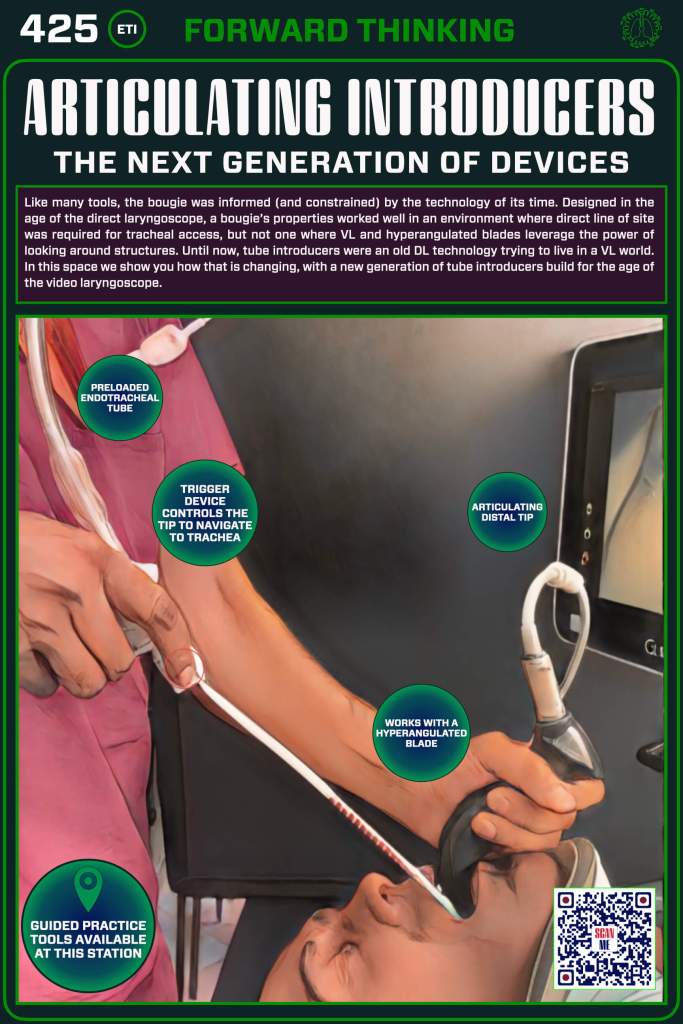
This poster has associated hands-on learning opportunities in our immersive and interactive physical space. If you’re with us in person, please visit the related station and use the self-guided resources here.
Curated MedEd
Pick up some great airway pearls related to this topic and build your learning network by checking out the curated FOAM educators we have for you here. 🧼
Learn from a Master
One of our favorite FOAM educators! Dr Yen Chow and his excellent video on the preloaded bougie. Please pay particular attention to how he holds it. Then follow him on Twitter for regular airway pearls (we do).
The Bottom Line
Precision & Efficiency
The preloaded bougie technique offers a streamlined approach to bougie-assisted intubation, especially for solo operators who need to maximize efficiency. By keeping the ETT and bougie preloaded as a single unit, this method allows for faster transitions, smoother tube placement, and improved control in high-stakes situations. However, be mindful of its limitations—shortening the bougie’s effective length may reduce the ability to access the tracheal. Like any airway technique, practice and adaptability are key—mastering this D-Grip variation can be a powerful addition to your airway management skillset.
What’s Next
Find Or Click Me
Nice work—you’re through this section! To keep going, scan the QR code on the physical poster at the next station in our pop-up training space to access the next set of digital content. Prefer to stay online? Just click the poster image here to continue your journey.
You must be logged in to post a comment.